 Login
Login


 Products


 Go Back to blog listing page
Franking vs Stamping: What’s the Difference for Home Loan & Property Documents



Purchasing your first home is one of the biggest milestones. There are many legal terms you will encounter during the long process of buying property that may be new to you. As you progress on this journey, you are likely to come across two terms, franking and stamping. Both are related to the payment of the compulsory stamp duty for your property documents but have different functions and different administrative procedures.
It is important to know the difference between franking and stamping, so that your property documents are legally valid and can carry weight in any future legal proceedings. This guide will break down these concepts so that you can move forward with the home-buying process with complete confidence.
Understanding Stamp Duty
Before getting into the technical differences, it is important to understand the concept of stamp duty. Stamp duty is a tax paid on various legal documents, such as sale agreements, mortgage deeds or lease agreements, etc., to the state government. Payment of this duty makes a document legally enforceable in a court of law. If a document is not stamped properly, it cannot be accepted as valid proof, and this could lead to serious complications if you ever have to get involved in legal disputes about your ownership or the terms of your contract.
What is Stamping?
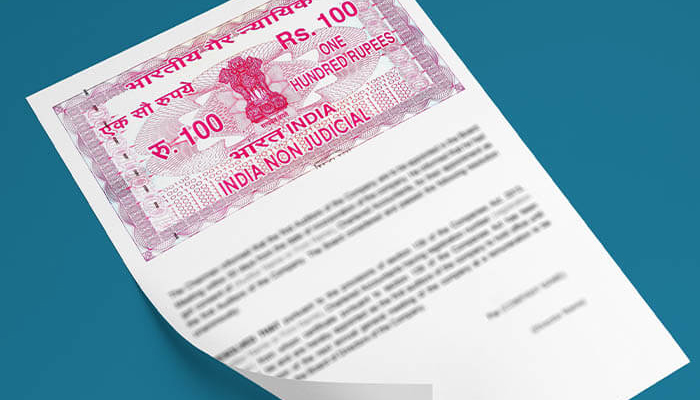
Stamping is the traditional, old way of paying stamp duty. This can be done by way of physically purchasing stamp paper from an authorised government vendor or treasury in the locality. Then you print or handwrite your legal agreement on this non-judicial stamp paper.
In many states, the value of stamp paper has to be exactly equal to the amount of stamp duty payable for that kind of transaction and the value of the property. When the transaction value is high, you might have to use multiple sheets of physical stamp paper to reach the total duty value required, which can be difficult to manage sometimes.
Also read: How Stamp Duty and Registration Charges are Calculated on Property?
Advantages of Stamping
-
Widely accepted across India.
-
Applicable where digital means are not readily available.
-
Acts as evidence that stamp duty has been paid.
Disadvantages of Stamping
-
Availability of high-value stamp papers can be challenging.
-
The document can be lost or damaged.
-
It is a time-consuming process compared to other methods.
What is Franking?
Franking is the modern, tech-enabled way to pay your mandatory stamp duty. You take your legal document printed on standard plain paper to an authorised bank or designated franking agency instead of searching for and buying physical stamp paper.
These agencies use a special high-security franking machine that prints a stamp or a specific seal directly onto your document. This seal is official evidence that the stamp duty on that document has been paid. For many borrowers, franking is a great convenience as it saves them the unnecessary hassle of getting physical stamp paper, which can sometimes be in short supply or difficult to procure in certain areas.
Advantages of Franking
-
Easy and quick documentation process.
-
Elimination of the use of stamp paper physically.
-
Appropriate for valuable business dealings.
Disadvantages of Franking
-
Limited to authorised organisations only.
-
State-dependent acceptance and procedures.
-
Could require a little processing cost in some places.
Key Differences Between Franking and Stamping
To help you distinguish between the two methods, here is a quick comparison table:
|
Feature |
Stamping |
Franking |
|
Medium |
Physical stamp paper |
Plain paper with franking seal |
|
Process |
Purchase stamp paper before document execution |
Execute the document and obtain franking |
|
Convenience |
Can be time-consuming |
Generally faster |
|
Availability |
Widely available |
Limited to authorised agencies |
|
Legal Validity |
Legally valid when properly stamped |
Legally valid when properly franked |
|
Storage |
Requires stamp paper |
Standard document format |
|
Cost |
Stamp duty payable |
Same stamp duty payable |
|
Best Use Case |
Traditional transactions |
Modern property documentation |
Costs, Legal Validity, and Registration Requirements
Another myth is that stamp duty is different when it comes to franking and stamping. In fact, the stamp duty is the same irrespective of whether you choose one of the methods over the other. The only thing that differs between the two methods is how you register the payment.
In some states, there might be a nominal service fee when using the method of franking. The registration fee, if any, is another expense that needs to be paid alongside the stamp duty.
Legally, all documents that conform to state laws in terms of franking and stamping are considered valid. When registering property, the sub-registrar confirms whether the stamp duty has been paid. Improperly stamped or franked documents may attract penalties or be rejected for registration.
State Documentation Practices and Affordable Housing
Documentation practices may vary depending on the state in which the property is located, for first-time home buyers and borrowers in smaller cities and towns. While some states have fully equipped franking and e-stamping systems, others may still be more reliant on traditional stamp paper-based processes.
If you are buying a property under affordable housing schemes, especially government-sponsored ones, knowing the local registration formalities beforehand can help you avoid undue delays and compliance issues during the home-buying process.
Also Read: 7 Tips For First Time Home Loan Buyers
A Real Life Scenario for a Borrower
Let's take a first-time home buyer in a Tier-2 city buying a flat with the help of a home loan. During registration, the buyer finds out that the local authority accepts franking in lieu of costly physical stamp papers.
By paying the stamp duty through an authorised franking agency, the buyer can complete the documentation process more efficiently while ensuring that the property documents remain legally valid. The failure to properly stamp or frank the documents could have resulted in delays in the registration process or additional compliance requirements.
Why getting your Documentation Right Matters
Proper payment of stamp duty safeguards your right to ownership and prevents possible disputes in the future. Be it stamping, franking, or e-stamping, compliance with the relevant regulations will ensure the enforceability of the documents related to your property.
Proper documentation will also facilitate any further transactions in the future, including resale, refinancing, or passing the ownership on to heirs, etc.
Conclusion
The financial and legal landscape of purchasing a home can be a labyrinth. From knowing the nuances of stamp duty to knowing about government schemes like PMAY-U 2.0 or calculating your monthly instalments using an Equated Monthly Instalment (EMI) calculator, the right information makes a world of difference.
At IIFL Home Loans, we help you understand these processes. They provide transparent information and tech-enabled services to make your journey to your dream home as smooth as possible. If you are looking for support, you can explore their home loan options on the IIFL Home Loans website.
Tags

Most Read Blogs




Frequently Asked Questions (FAQ’s)
Is franking mandatory for property registration?
Ans:
No. Depending on state regulations, stamp duty can be paid through stamping, franking, or e-stamping.
Is e-stamping legally valid?
Ans:
Yes. E-stamping is legally recognised and accepted in many states as proof of stamp duty payment.
Does franking cost more than stamping?
Ans:
No. The stamp duty amount remains the same, although a small franking service fee may apply in certain states.
Can home loan agreements be franked?
Ans:
Yes. In many states, home loan agreements and mortgage documents can be franked, subject to local regulations and lender requirements.
Which is better: stamping, franking, or e-stamping?
Ans:
The best option depends on state regulations, availability, convenience, and the requirements of the registration authority and lender.
What can we help you with?

Home Loan

Secured Business Loan

Balance Transfer

Home Improvement Loan

Home Loan for Uniformed Services

NRI Home Loan
Home Loan
Secured Business Loan
Balance Transfer
Home Improvement Loan
Home Loan for Uniformed Services
Get instant support with existing loan related queries

Raise a Request Get instant access to your existing Loan Account with us Raise a Ticket 

Call Helpline Speak with our Customer Support Executive on 1860 267 3000

Visit Nearby Branch You can walk into any of our 300+ branches, spanning across 18 states Get Directions
Our Brands & Subsidiaries


Insurance Partners


HDFC Life Insurance
Learn more
Bajaj Life Insurance
Learn more
ICICI Prudential Life Insurance
Learn more
Go Digit General Insurance
Learn more
Aditya Birla Capital Insurance
Learn more
Bajaj Allianz General Insurance
Learn more


