 Login
Login


 Products


 Go Back to blog listing page
Should you switch to a fixed-interest Home Loan as rates rises?



October 09, 2024
1 min
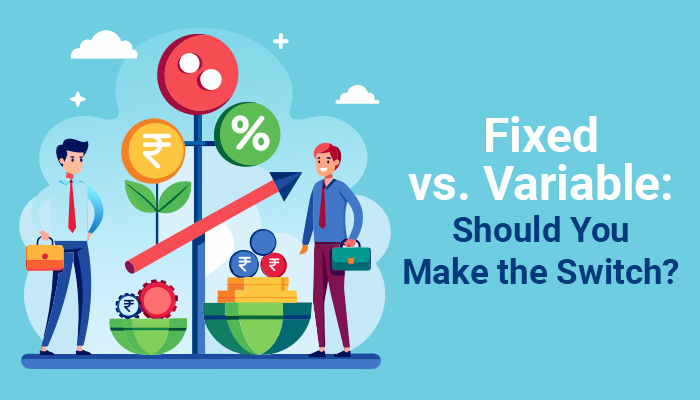
While availing of home loans, the fixed vs floating home loan interest rate debate often leaves homebuyers in a dilemma. Most opt for floating interest rates, simply because the rates are lower than the home loan fixed interest rate. However, floating rates come with uncertainties. What happens if the interest rate starts to rise unexpectedly? What should you do in such scenarios? This blog will help you understand the difference between floating and fixed-interest rate home loans.
Home Loan Interest Rate - Fixed or Floating
Wondering what is a fixed interest rate home loan and how it differs from a floating rate loan? A fixed interest rate means that the home loan interest rate will remain constant throughout the loan tenure, as determined during loan approval. In contrast, a floating interest rate loan implies that the home loan interest rate will change subject to the changes in the repo rate set by the government or RBI (Reserve Bank of India). It is crucial to carefully review the home loan agreement.
Here’s a quick comparison between home loan fixed interest rates and floating interest rates:
| Parameters | Fixed Interest Rate Loans | Floating Interest Rate Loans |
|---|---|---|
| Interest Rate | Higher interest rate | Lower interest rate |
| External Influence | Unaffected by external factors or changes in interest rates | Varies with market conditions and government policies |
| EMI Amount | Remains fixed throughout the loan tenure | Can fluctuate based on the changes in the interest rate |
| Budgetary Planning | Budget planning for borrowers is simple as the EMI remains fixed | Budget planning can become tricky if there are constant changes in the interest rate |
| Suitability | Suitable for short-term loans | Best for long-term loans |
| Risk Factor | Lower risk as the uncertainty around interest rates gets eliminated | Higher risk due to rate variability |
What to do during rising Interest Rates?
WIf inflation rises significantly, the government may increase the interest rate to reduce borrowing and control spending. This lowers demand and helps control prices. However, borrowers with long-term loans, such as home loans, may see their borrowing costs rise. This is where understanding home loan amortization becomes important. A question emerges – whether such borrowers should shift to fixed rate home loans in such a scenario?
You should evaluate this scenario based on the following parameters:
- Loan Tenure: A fixed interest rate is ideally suitable for short-tenure loans, while floating rates are more favorable for long-term loans. If your home loan has a long remaining tenure, you might want to stick with floating rates.
- Rate Difference: You should check the difference between a home loan at a fixed interest rate and a floating interest rate. For some banks, the difference may be small (1%-1.5%), while for others it could be significant (2%-3% or even more). Many borrowers choose floating rates for this reason.
- Future Probabilities: What are the future probabilities and possible government policies? Is the rising interest rate trend to be continued, or is it a one-time action by the government? These questions will help you decide whether to shift to a fixed interest rate or continue with the floating interest rate.
In a Nutshell
During times of rising interest rates, shifting to the fixed interest rate option seems attractive. However, it is important to consider the above factors before you shift as your decision carries financial consequences. Making the right choice and being patient and aware is better than choosing short-term gains due to fluctuations. Further, it is important to have the right lending partner that provides you with flexibility and convenience.
IIFL Home Loans provides you with home loans at one of the most affordable interest rates and flexible tenure. You can also use the IIFL Home Loan calculator to estimate the interest outflow as well as monthly EMI payments to be made.
Tags

Most Read Blogs





Frequently Asked Questions (FAQ’s)
Q1: What is better - a home loan interest rate fixed or floating?
Ans:
Fixed interest rate can be better for short-term loans while a floating interest rate is considered more suitable for long-term loans.
Q2: How to use a home loan EMI calculator?
Ans:
Using a home loan calculator is simple. You just need to enter the loan amount, tenure and interest rate. You will get the EMI amount payable each month as well as the total interest outflow.
Q3: Why fixed interest rates are higher than floating interest rates?
Ans:
The fixed interest rates are higher than the floating interest rate because, in the case of a fixed interest rate, the financial institution bears the risk of changes in interest rates. So, if the interest rate increases, the financial institution's profit reduces as the increased interest cost is not passed on to the borrowers.
Q4: When floating interest rate can increase?
Ans:
A floating interest rate can increase if the government increases the interest rate i.e., the repo rate.
Q5: Can I change my interest rate from floating to fixed or vice versa during the loan tenure?
Ans:
Most banks allow changing interest rate types from floating to fixed or vice versa during the tenure of the loan.
What can we help you with?

Home Loan

Secured Business Loan

Balance Transfer

Home Improvement Loan

Home Loan for Uniformed Services

NRI Home Loan
Home Loan
Secured Business Loan
Balance Transfer
Home Improvement Loan
Home Loan for Uniformed Services
Get instant support with existing loan related queries

Raise a Request Get instant access to your existing Loan Account with us Raise a Ticket 

Call Helpline Speak with our Customer Support Executive on 1860 267 3000

Visit Nearby Branch You can walk into any of our 300+ branches, spanning across 18 states Get Directions
Our Brands & Subsidiaries


Insurance Partners


HDFC Life Insurance
Learn more
Bajaj Life Insurance
Learn more
ICICI Prudential Life Insurance
Learn more
Go Digit General Insurance
Learn more
Aditya Birla Capital Insurance
Learn more
Bajaj Allianz General Insurance
Learn more


