Login
Login


 Products


 Go Back to blog listing page



Purchasing a house is one of the major financial decisions that you will be making. When comparing various home loan options, you are likely to encounter many terminologies such as principal amount, Equated Monthly Instalment (EMI), and interest. It is important that you thoroughly understand these terms to plan for effective borrowing and repayment.
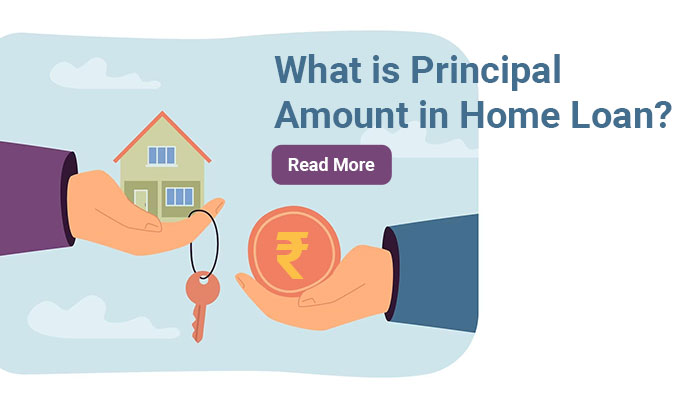
The principal amount for home loans is the amount of money you borrow from a lending institution when purchasing, constructing, or renovating a house. In your EMI, there is the principal and the interest, and how repayment is made efficiently impacts the cost of the entire loan.
In this guide, you will learn what the principal amount is, how repayment is done, how early repayment helps, and how to monitor the outstanding amount.
What Does the Principal Amount in Home Loans Mean?
The borrowed amount without the interest component is known as the principal amount. For instance, if you're buying a house worth ₹20 lakh, you opt for a ₹15 lakh home loan. In this case, your principal amount is ₹15 lakh.
Interest is computed on the remaining principal amount for the duration of the loan. When you start making EMI payments, the principal amount and the interest calculated against it keep decreasing.
| Component | Meaning |
|---|---|
| Principal Amount | Original amount borrowed |
| Interest | Cost of borrowing the principal |
| EMI | Monthly payment comprising principal and interest |
| Outstanding Principal | Remaining principal yet to be repaid |
Knowing the difference between these components helps you understand your repayment schedule and overall borrowing cost.
How Does Housing Loan Principal Repayment Work?
A home loan is generally repaid through monthly EMIs over a fixed tenure. Each EMI contains two parts:
- Interest repayment
- Principal repayment
In the early years, you would be making payments mostly on interest since the principal amount is higher. Over time, however, your interest payments will reduce while those on the principal part will increase.
For instance, let us assume you are a first-time homebuyer in a Tier-2 city and have taken a loan of ₹15 lakh. At first, you would pay most of your EMI on interest. But after many years, a larger chunk of your EMI will be paid towards the principal.
This gradual shift helps borrowers steadily build ownership of their property while repaying the loan.
Many borrowers use an EMI calculator to understand how principal and interest are distributed over the loan tenure before applying for a home loan.
Benefits of Early Principal Repayment
Early repayment of the principal amount or making partial payments may bring many benefits, depending on your lender's policies and terms.
Reduces Overall Interest
Since the interest amount is calculated based on the remaining principal amount, reducing the remaining principal amount would help save interest expenses.
Shortens Loan Tenure
Many people prefer keeping the same EMI after the prepayment without reducing it. This helps repay the loan faster.
Also read: Minimum vs. Maximum Home Loan tenure: which one should you choose?
Improves Financial Flexibility
Lower remaining principal will make it easier to plan for your future finances, which may include renovation, education, or even retirement.
Greater Peace of Mind
Paying off your debt early will give you financial security and will reduce your future repayment amounts.
However, before you decide to prepay, ensure that you read all the necessary terms and conditions of your loan.
How Principal Amount Affects Your Home Loan
The principal amount influences almost every aspect of your home loan.
EMI Amount
A higher principal generally results in a higher EMI if the tenure remains the same.
Total Interest Payable
The higher the principal amount, the higher the possibility of paying more interest during the loan tenure, depending upon the loan conditions.
Loan Tenure
Some people prefer longer tenures to ease their EMIs. Even though this reduces their monthly outflow, it could lead to higher overall interest.
Also read: What is the Repayment Tenure for Home Loan?
Loan Eligibility
The principal amount you can borrow depends on factors such as:
- Income
- Credit profile
- Existing financial obligations
- Property valuation
- Loan-to-Value (LTV) ratio
- Lender policies
Choosing a suitable principal amount that aligns with your repayment capacity is essential for maintaining financial stability.
How to Check the Outstanding Principal Amount of Your Home Loan?
Monitoring your outstanding principal helps you stay informed about your repayment progress.
You can usually check it through the following methods:
- Review your loan account through the lending company's portal.
- Download your loan statement annually.
- Review your loan amortisation schedule.
- Seek assistance from customer care regarding your outstanding loan balance.
- Request a loan account statement whenever required.
Regularly reviewing your outstanding principal can help you decide whether making a partial prepayment is suitable for your financial goals.
If you're planning a new home loan, using the EMI Calculator available on the IIFL Home Loans website can help you estimate your monthly repayments and understand how your principal reduces over time.
Wrapping Up
Understanding the home loan principal helps in making better decisions on borrowing. This will affect your EMI, the interest paid, the payment period, and the overall planning for your finances.
Regardless of whether you are buying your first home in a developing city or you are upgrading your current one, understanding the concept of principal repayment will help you make informed choices throughout the loan tenure.
IIFL Home Loans, a tech-enabled NBFC, supports homebuyers with financing solutions for home purchase, construction, renovation, balance transfer, and affordable housing. You can also explore useful resources, eligibility information, the EMI Calculator, PMAY-related guidance, and informative blogs on the IIFL Home Loans website to make well-informed housing finance decisions.