 Login
Login


 Products


 Go Back to blog listing page
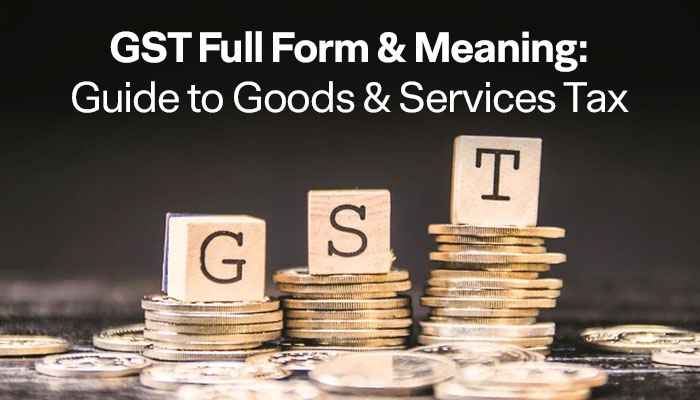
GST Full Form and Meaning: Complete Guide to Goods and Services Tax



September 11, 2025
1 min
If you've ever opened a bill and wondered what Goods and Services Tax (GST) means, you're not alone. Almost everything we buy, from groceries to homes, is impacted by GST, so it is important to understand what it is and how it works. This guide explains the GST full form and meaning in simple English, how the tax works in India, its types of GST, rates, registration rules, and impact on real estate. If you are a business owner or a curious consumer, this guide has GST explained in simple, easy-to-follow terms.
What is GST?
GST (Goods and Services Tax) is a destination-based indirect tax levied on the supply of goods and services in India. Introduced on 1 July 2017, it replaced multiple indirect taxes and created a unified taxation system across the country.
Under the 101st Constitutional Amendment Act, GST was launched on 1st July 2017. Prior to GST, a company operating in multiple states had to adhere to different tax rules in each state, and taxes were often imposed on taxes. This is known as the cascading effect or "tax on tax". GST was introduced to do away with this problem, broaden the tax base, make compliance easier, and create one common market across the country. It also introduced input tax credit, businesses could claim credit for tax already paid on purchases, so the overall tax burden was reduced.
How GST work in India?
GST is a multi-stage tax that is based on destination. Multi-stage means you pay at every point where value is added, from raw material to manufacturing to wholesale to retail to the customer. Destination-based means that the tax is paid to the state where the goods or services are actually consumed, not where they are produced.
Companies above a certain turnover have to register for GST, collect tax on sales, and pay tax on purchases. The net amount payable is calculated by deducting input tax credit. GST returns then need to be filed regularly, monthly, quarterly, or annually, depending on the type of taxpayer, as part of the standard GST return filing process to report sales, purchases, and tax paid.
What is GST vs VAT?
VAT, or Value Added Tax, was a state tax. It was only on goods and not services, and the rates differed from state to state. It also did not allow for easy credit between states, so goods often were taxed twice when they passed from one state to another. GST is not the same. It is a single tax for goods and services under the same law, permits input tax credit across the supply chain, and has uniform rates throughout the country. This makes GST compliance easier to track and makes trade between states much easier than it was under VAT.
For quick read, refer to table below:
|
Feature |
GST |
VAT |
|
Applies To |
Goods & Services |
Mainly Goods |
|
Coverage |
Nationwide |
State-based |
|
ITC |
Wider availability |
Limited |
|
Interstate Trade |
Easier |
More complex |
Registration under GST
Registration thresholds may vary based on the nature of business, turnover, and applicable regulatory provisions. The limit differs for goods and services and differs by state. Businesses should verify the latest eligibility criteria before registering. There are also certain entities that are required to register mandatorily irrespective of turnover, such as e-commerce operators, businesses supplying goods or services across state borders, casual taxable persons, and persons required to deduct or collect tax at source. Businesses that do not meet the threshold can also register voluntarily if they want to claim input tax credit or want to appear more credible to bigger clients.
Once registered, a business is assigned a unique GSTIN (GST Identification Number). It must then file GST returns regularly, issue GST-compliant invoices, and maintain proper records.
Documents Required for GST Registration
-
PAN card of business or applicant
-
Copy of business registration/certificate of incorporation
-
Identity and address proof with photographs for promoters/directors
-
Proof of address of the business premises (electricity bill/rent agreement/ownership document)
-
Bank statement or cancelled cheque leaf
-
Digital signature (for LLPs and companies)
-
Letter of authorisation or board resolution of the authorised signatory
The GST Council and CBIC make amendments to the GST Registration rules and document requirements from time to time. It is recommended to check the official GST portal for the latest requirements before you apply.
Also Read: Home Loan Tax Benefits: New vs Old Regime 2026
Advantages & Disadvantages of GST
Here are the benefits and disadvantages of GST:
Benefits:
-
Cascading effect of multiple indirect taxes removed
-
Creates a single national market with uniform tax rates nationwide
-
Makes tax more transparent with online filing and tracking of input tax credit
-
Makes trading easier, especially between states
-
Broadens the tax base and improves GST compliance in the long term
Disadvantages:
-
For small businesses, compliance can be a complicated process; returns must be filed on a regular basis
-
Businesses had to adapt their accounting and billing systems when GST was first implemented
-
Even with fewer rate slabs in place now, certain products can still be hard to classify correctly
-
The changes in rates mean businesses need to update their billing and pricing systems quite often
Also Read: How to Secure a Business Loan: A Complete Guide
Types of GST in India
So, what are the types of GST in India? Indeed, GST in India is split into four parts, depending on the kind of transaction:
-
CGST (Central GST): Collected by the Central Government on sales within the same state.
-
SGST (State GST): Collected by the State Government on that same within-state sale along with CGST.
-
IGST (Integrated GST): Charged by the Central Government on sales and imports across state boundaries. This revenue is then shared between the centre and the state of destination.
-
UTGST (Union Territory GST): It is used in place of SGST for supplies within Union Territories without a legislature, such as Chandigarh or Lakshadweep.
So, in case of sale within the same state, CGST and SGST are both charged and shared equally. In a sale between two states, only IGST is applicable.
GST Rates and Slabs You Should Know
GST rates are periodically reviewed and revised by the GST Council. Businesses and consumers should refer to the latest official notifications for current GST rates and classifications. The old five-tier structure of 0%, 5%, 12%, 18%, and 28% has been replaced with a simpler system:
-
0% (Nil rate): Unbranded essential food staples, some life-saving drugs, educational materials, and individual health and life insurance
-
5%: Everyday necessities, farm products, and healthcare items
-
18%: The standard rate, imposed on most goods and most services, including many products that were earlier in the old 12% and 28% slabs
-
40%: A special rate for luxury and "sin" products such as high-end vehicles, tobacco products, pan masala, and aerated drinks. This supersedes the earlier slab of 28% plus compensation cess
There are still some special rates for niche items such as precious metals and diamonds at 0.25%, 1.5%, and 3%. GST rates and classifications are reviewed periodically by the GST Council, so it's worth double-checking current HSN or SAC code mappings before you invoice.
GST Impact on Real Estate Transactions
GST directly impacts buying property and building costs as part of broader real estate taxation rules in India, but this depends on the type and stage of the property:
-
GST is applicable on under-construction properties because the sale is for a part of the construction service. GST is not charged on ready-to-move-in properties with a completion certificate. These are considered the sale of immovable property and not a service.
-
For affordable housing projects, the GST rate is generally lower and concessional. In contrast, other residential projects are liable to the standard rate, usually with no input tax credit for the buyer.
-
Resale of properties or transactions involving land alone are not covered under the scope of "supply" under GST law, and hence GST is not applicable.
-
For homebuyers, it is important to know whether a project is classified as affordable or standard housing and whether it is under construction or ready for occupancy, as this will determine the actual GST impact on real estate and the final price.
Also read: GST on Flat Purchase Guide for Home Buyers
Real estate GST rates and exemptions can change with new policy, so it's best for buyers and developers to check current rates with a tax professional or the official GST portal before finalising a deal. Understanding GST on home purchase in India helps buyers budget accurately for their property investment.
Conclusion
Buying a home is one of the biggest financial decisions you will make, and understanding taxes like GST is just one part of planning it well. At IIFL Home Loans, we aim to make the rest of the journey just as simple, from checking your eligibility to disbursing your loan quickly, with transparent terms and no hidden charges. Whether you are buying your first home, an under-construction property, or looking to transfer your existing loan for a better rate, our team is here to guide you through every step. Get in touch with IIFL Home Loans today to find a home loan that fits your needs and turn your property plans into reality.
Tags

Most Read Blogs



Frequently Asked Questions (FAQ’s)
What is the GST full form?
Ans:
GST full form is Goods and Services Tax; a single indirect tax applied on the supply of goods and services in India.
What are the types of GST in India?
Ans:
There are four types of GST. CGST and SGST are collected on sales within a state. IGST is levied on sales between states and on imports. UTGST is collected in lieu of SGST in Union Territories without their own legislatures.
Who needs GST registration?
Ans:
Any business which crosses the set turnover threshold needs to register. Some businesses (e.g. e-commerce operators or inter-state suppliers) are required to register regardless of their turnover. Others may register on their own.
What is the present GST rate in India?
Ans:
The main GST Rates in India after the September 2025 GST 2.0 reforms include 0%, 5%, 18%, and 40%, with some special rates for items such as precious metals. This replaced the previous structure, which had 12% and 28% slabs.
Do I pay GST when I buy a home?
Ans:
Depends. GST is not applicable on ready-to-move-in properties having a completion certificate. Under-construction properties are subject to GST. Resale properties and land-only transactions are not subject to GST.
What can we help you with?

Home Loan

Secured Business Loan

Balance Transfer

Home Improvement Loan

Home Loan for Uniformed Services

NRI Home Loan
Home Loan
Secured Business Loan
Balance Transfer
Home Improvement Loan
Home Loan for Uniformed Services
Get instant support with existing loan related queries

Raise a Request Get instant access to your existing Loan Account with us Raise a Ticket 

Call Helpline Speak with our Customer Support Executive on 1860 267 4999

Visit Nearby Branch You can walk into any of our 300+ branches, spanning across 18 states Get Directions
Our Brands & Subsidiaries


Insurance Partners


HDFC Life Insurance Learn more
Bajaj Life Insurance Learn more
ICICI Prudential Life Insurance Learn more
Go Digit General Insurance Learn more
Aditya Birla Capital Insurance Learn more
Bajaj General Insurance Learn more


